
Designing a Home Cinema Experience at Home
A genuine cinema experience begins long before the screen. From acoustic design to Dolby Atmos speaker placement, here's how to engineer a true private theatre.
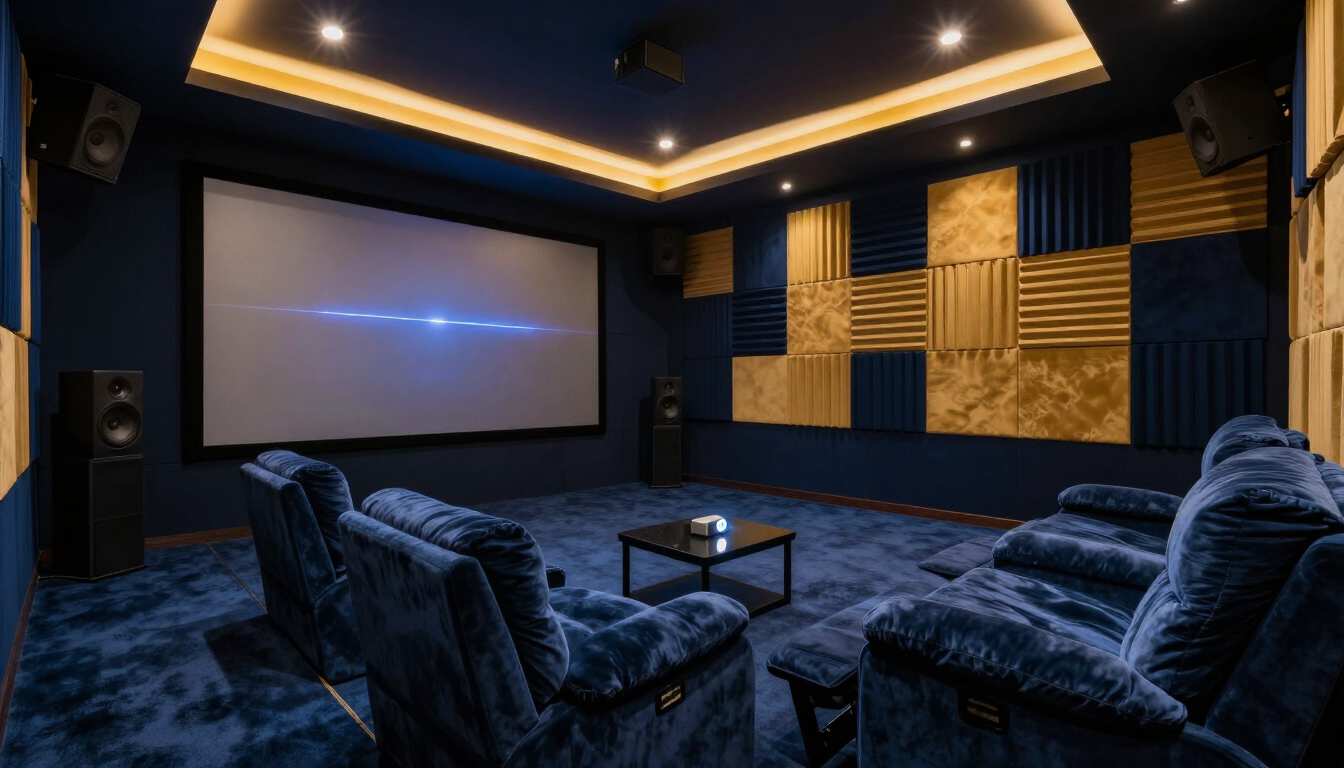
Beyond the Big Screen
The dream of a private home cinema is older than the technology required to realise it. But the gap between a large television in a darkened room and a genuine cinematic experience is wider than most people appreciate — and it has very little to do with the size of the screen.
A true home cinema is an acoustic and sensory environment. The projector and screen are the final elements of a design process that begins with the room itself.
Choosing the Right Space
The ideal home theatre occupies a dedicated room, preferably below grade or on an internal wall, where external noise can be controlled and sound from the room doesn't disturb the rest of the home. Rectangular rooms with a length-to-width ratio between 1.6:1 and 1.8:1 are acoustically favourable, reducing the modal resonances that make bass frequencies uneven at the listening position.
Ceiling height matters. A minimum of 2.7 metres is recommended for a Dolby Atmos overhead speaker array; 3 metres or more allows the height channels to perform at their best.
Acoustic Treatment: The Foundation of the Experience
No amount of speaker quality compensates for an acoustically untreated room. Bare walls, hard floors, and glass surfaces create early reflections — delayed copies of direct sound that blur imaging, smear dialogue, and make the listening experience fatiguing.
Professional acoustic treatment addresses three areas:
Absorption reduces mid and high frequency reflections using fabric-wrapped panels at first-reflection points — the side walls adjacent to the primary seating position, the rear wall, and the ceiling between the screen and the seating. The goal is not a dead room but a controlled one.
Bass trapping addresses the low-frequency modal resonances that cause audible unevenness in bass reproduction. Floor-to-ceiling broadband absorbers in room corners are the primary tool, supplemented by tuned resonators where specific problem frequencies are identified.
Diffusion preserves the sense of liveliness and ambience that makes music recordings and film soundtracks feel dimensional and enveloping. Diffusive surfaces at the rear and upper side walls scatter sound in a controlled way, maintaining acoustic energy without reinforcing specific reflections.
The Dolby Atmos Speaker Array
Dolby Atmos is an object-based audio format that allows sound designers to place individual sonic elements anywhere in three-dimensional space. To reproduce this accurately, the loudspeaker system must surround the listening position not just horizontally but vertically.
A reference Dolby Atmos layout for a private cinema is typically described in three numbers — bed channels, surround channels, and height channels. A 7.1.4 configuration, for example, delivers seven horizontal channels, one subwoofer, and four overhead speakers. For the most serious installations, a 9.1.6 or 11.4.6 array is achievable in appropriately sized rooms.
The subwoofer — or ideally multiple subwoofers — is the most room-dependent element of the system. Professional calibration using measurement software (such as Audyssey MultEQ XT32 or the proprietary tools from Trinnov Audio) corrects for room-induced frequency response anomalies, time alignment differences, and level matching between all channels.
Projection and Screen
A 4K laser projector is now the reference standard for premium home cinema. Unlike lamp-based projectors, laser light sources offer significantly longer operational life (20,000+ hours), consistent brightness throughout their lifespan, and colour gamut coverage that approaches DCI-P3 — the colour space used in commercial cinema post-production.
Screen gain, surface texture, and ambient light rejection characteristics should be matched to the projector's brightness output and the room's residual light levels. For rooms with complete light control, a matte white screen (gain 1.0–1.3) provides the most accurate image and widest viewing cone. For rooms where some ambient light is unavoidable, ambient light rejection (ALR) screens that are optimised for the projector's throw angle are the preferred solution.
Motorised screens integrate naturally with home automation. A single "Cinema" scene can lower the screen, close motorised blackout blinds, dim all room lighting to a calibrated level, power on the projector and AV receiver, and switch inputs — all simultaneously, triggered by a single button press or voice command.
Integration with Home Automation
The home cinema experience reaches its full potential when integrated with the broader smart home ecosystem. Automation adds precision, consistency, and effortlessness to every session:
Pre-programmed scenes handle the transition from ambient room mode to full cinema mode in seconds. Motion sensors in the seating area can automatically pause playback if all viewers leave the room. Climate control in the theatre can be isolated from the rest of the home, maintaining a comfortable temperature without the noise of a ducted system activating mid-film.
After viewing, a single command returns the room to social mode — screens retract, lights rise to a warm, welcoming scene, and the AV system powers down in the correct sequence.
The Svelte Approach
Svelte Technologies designs home cinemas as complete acoustic and technical environments. The process begins with the room dimensions and ends with a calibrated, certified installation — with acoustic modelling, system design, and professional calibration completed before a single speaker is physically placed.
A private cinema is one of the highest-expression investments a home can carry. Designed correctly, it is also one of the most deeply satisfying.
From the Journal
Begin Your Journey
Let us design a space
that thinks with you.
Every intelligent home begins with a conversation. Book a complimentary consultation and let our specialists craft a solution around your lifestyle.